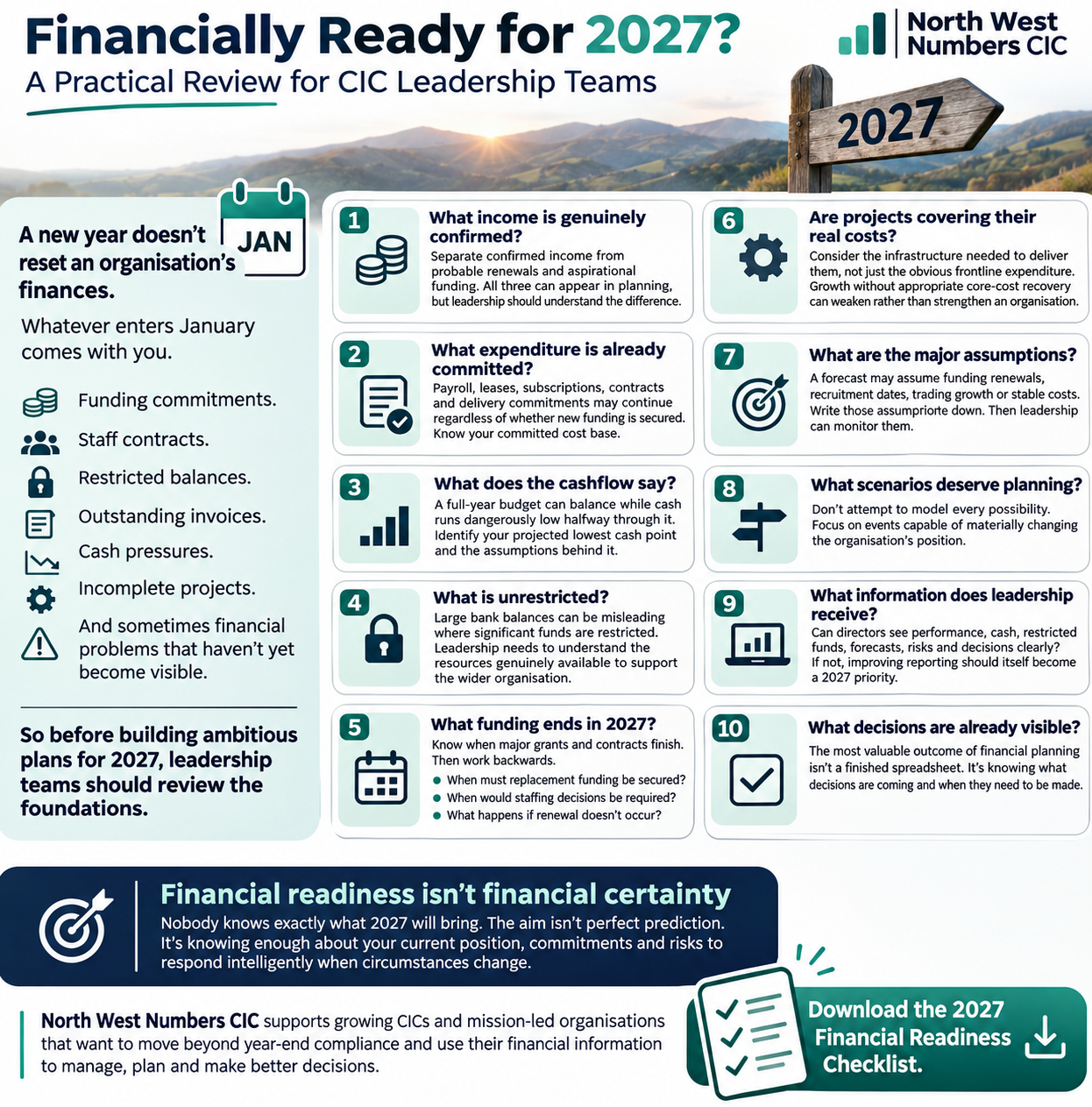
January does not reset an organisation's finances. Existing staff commitments, restricted balances, incomplete projects, supplier obligations and funding uncertainty all travel into the new year. A useful 2027 plan therefore begins with the position you actually have, not a blank spreadsheet or last year's budget with the dates changed.
Start with income certainty
Separate 2027 income into confirmed, probable and aspirational. A £500,000 income plan looks very different if £420,000 is contracted than if only £120,000 is secure. Potential income can still be included, but leadership needs to see the uncertainty rather than allowing one total to disguise it.
Map committed expenditure
List costs that continue regardless of new funding: payroll, leases, subscriptions, contracts and existing delivery commitments. Then identify expenditure that is conditional on new income. This distinction helps leadership know what can and cannot be changed if assumptions fail.
Forecast cash, not just surplus
A full-year budget may balance while cash falls dangerously low halfway through the year. Plot the timing of major receipts and payments and identify the lowest expected cash point. Then test how sensitive it is to delays in funding or changes in delivery.
Know what funding ends
For every material grant or contract ending in 2027, work backwards from the end date. When would replacement income need to be secured? When would staffing decisions become necessary? What happens if renewal is late or unsuccessful?
Make assumptions visible
Every forecast contains assumptions. Good leadership does not pretend otherwise. Record the assumptions that would materially change the result and decide how they will be monitored. This turns uncertainty into something manageable.
Use scenarios for the big uncertainties
A base case, stretch case and downside case can be enough. The purpose is not to create three elaborate spreadsheets; it is to understand which decisions change if key income, costs or timings change.
Review the finance function itself
Can your current system produce timely information on performance, cash, restricted funds, forecasts and risks? If management information depends on repeated spreadsheet reconstruction or arrives too late to influence decisions, improving the finance process should itself be a 2027 priority.
What this means in practice
The most useful output from planning is not a perfectly balanced spreadsheet. It is clarity about what is secure, what is uncertain, what the organisation has already committed to and which decisions are coming. Financial readiness is not certainty about 2027; it is being prepared to respond when reality differs from the plan.
Use the 2027 Financial Readiness Checklist to take this discussion into your next leadership meeting.